Overview
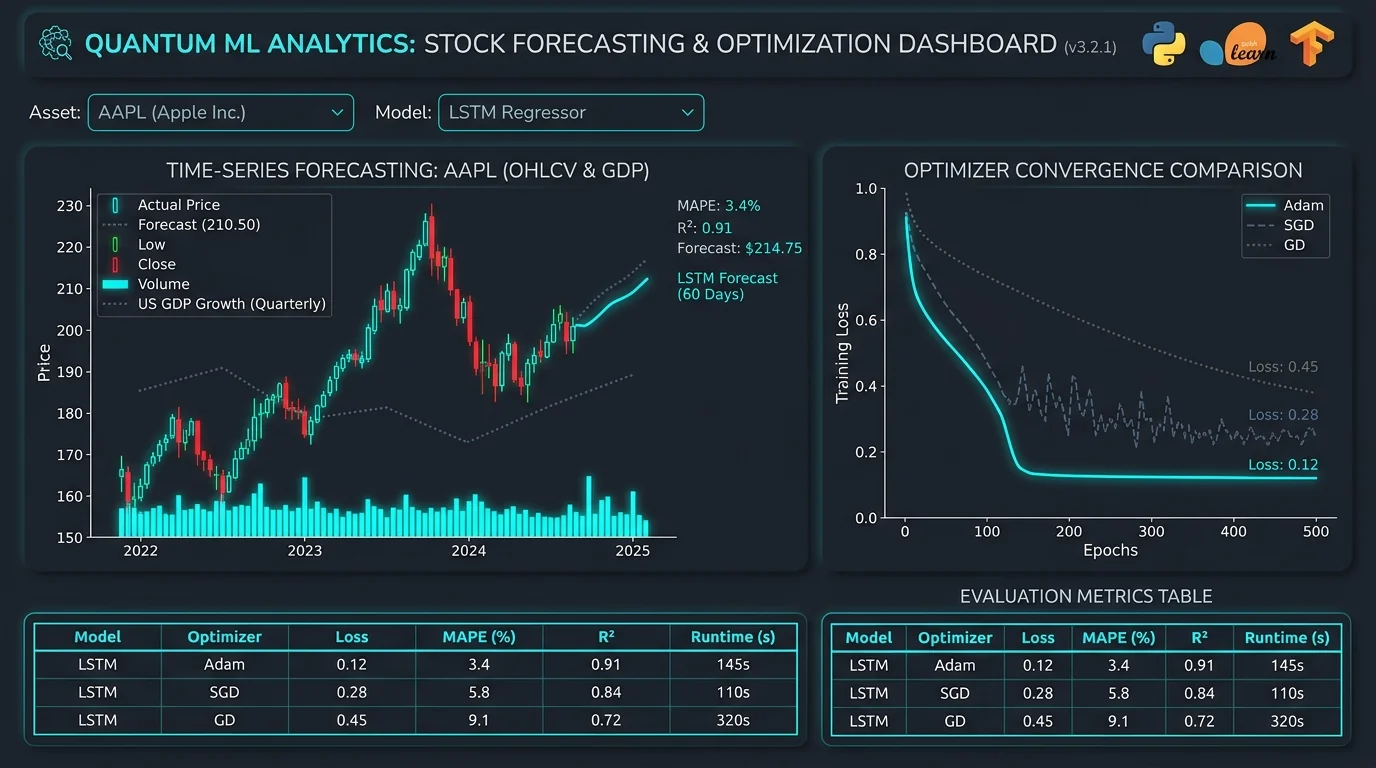
Comprehensive Machine Learning coursework addressing 3 distinct foundational challenges: (1) Empirical convergence comparison of gradient optimization methods on Boston Housing; (2) Stock Open Price time-series forecasting using a 60-day sliding window; (3) Handwritten digit classification on MNIST using CNNs.
System Architecture
Diverse architectural implementations: FFNN (Dense 50-50-1) & stacked LSTM networks for time-series; 2-stage Conv2D CNN with Dropout for MNIST; Decision Tree Regressor and Linear models as baselines.
Data & Database
HousingData.csv (506 rows x 14 cols) for optimization analysis; data_src_2.csv (6,816 rows x 10 cols containing OHLCV, Tickers, Industry, GDP) for stock forecasting; benchmark MNIST dataset.
Key Challenges & Technical Solutions
- 01
1. Comparative Benchmark of 7 Gradient Optimizers:
Implemented and evaluated Batch GD, SGD, Mini-batch GD, Momentum, Adagrad, RMSProp, and Adam on Boston Housing, plotting epoch loss trajectories to illustrate convergence speed.
- 02
2. 60-Step Sliding Window Feature Engineering:
Filtered data by ticker, preserved chronological sorting, applied MinMaxScaler to Open prices, and constructed 60-step lookback sliding windows for next-day open price prediction.
- 03
3. Overfitting Curtailment in Time-Series Neural Models:
Benchmarked LSTM vs FFNN vs Decision Tree using MSE and R² metrics; leveraged Dropout, L2 Regularization, and EarlyStopping in Keras to curtail overfitting.